
Build a Business That Runs Without You: A Practical Definition

A business that runs without you is one where the day-to-day operations no longer require your presence to function — not so you can step away, but so you can lead. The test isn't whether you take a vacation. The test is whether your daily attention is spent on the work only you can do, instead of being consumed by work anyone else with the right system could do.
The Phrase Gets Misunderstood
"Build a business that runs without you" gets reduced, in most business writing, to a lifestyle pitch. The four-hour work week. The beach. The hand-off-and-disappear fantasy.
That's not what we mean.
A business that runs without you isn't a business you've abandoned. It's a business where the structural decisions are yours, the strategic direction is yours, the standards are yours — but the daily fires don't have to land on your desk because the system is designed to catch them where they happen.
"Runs without you" doesn't mean you're not present. It means you're present where it matters — and absent where you shouldn't be the bottleneck.
Why Most Leaders Get This Wrong
When a leader who built something successful tries to step back, the typical result is one of three failure modes:
- The collapse. Decisions stop getting made. Quality drops. The business stalls. The leader gets pulled back in — confirming the belief that they're irreplaceable. The cage door closes.
- The proxy. A senior person is promoted into the leader's role, gets overwhelmed, recreates the same dependency pattern with themselves at the center. Now there are two bottlenecks instead of one.
- The hollowing. The leader withdraws gradually but never solves the underlying dependency. The business runs on cultural momentum from the leader's prior presence. It works for a year. Then it doesn't.
All three fail because they treat the problem as a delegation problem. It isn't. It's an architecture problem.
What the Architecture Looks Like
A business that genuinely runs without you in the middle of everything has four structural properties. Most businesses missing one or more of these can't get there no matter how hard the leader tries to delegate.
1. Decisions get made where the information lives
If the only person with full visibility across systems is you, every cross-functional decision routes to you by default. The fix isn't more meetings. It's making the information visible to the people who need it, when they need it, in the channel they already work in. That's an intelligence layer — not a delegation chart.
2. The exceptions get surfaced; the routine gets handled
Healthy businesses don't escalate everything to leadership. They escalate exceptions. If exceptions can't be detected automatically, every uncertainty looks like an exception — and your team brings everything to you, which is what makes you the bottleneck. A signal engine that knows what's normal vs. what's notable solves this at the architecture level.
3. The standards are codified, not held in your head
If your team has to ask you what "good" looks like, you become the quality gate for every decision. Codify it. Write it down. Build it into the system. Your standards should be retrievable without retrieving you.
4. The strategic work has room to happen
If your calendar is consumed by daily operations, you can't actually do the work only you can do — long-range strategy, relationship building, hard hiring decisions, the things that move the business forward. "Runs without you" creates the conditions for strategic work to exist. If you free the calendar but don't move into the strategic space, the calendar fills back up with operations.
The Test
If you want to know whether your business runs without you in the middle of everything, don't measure it by whether you can take a vacation. Measure it by these five questions:
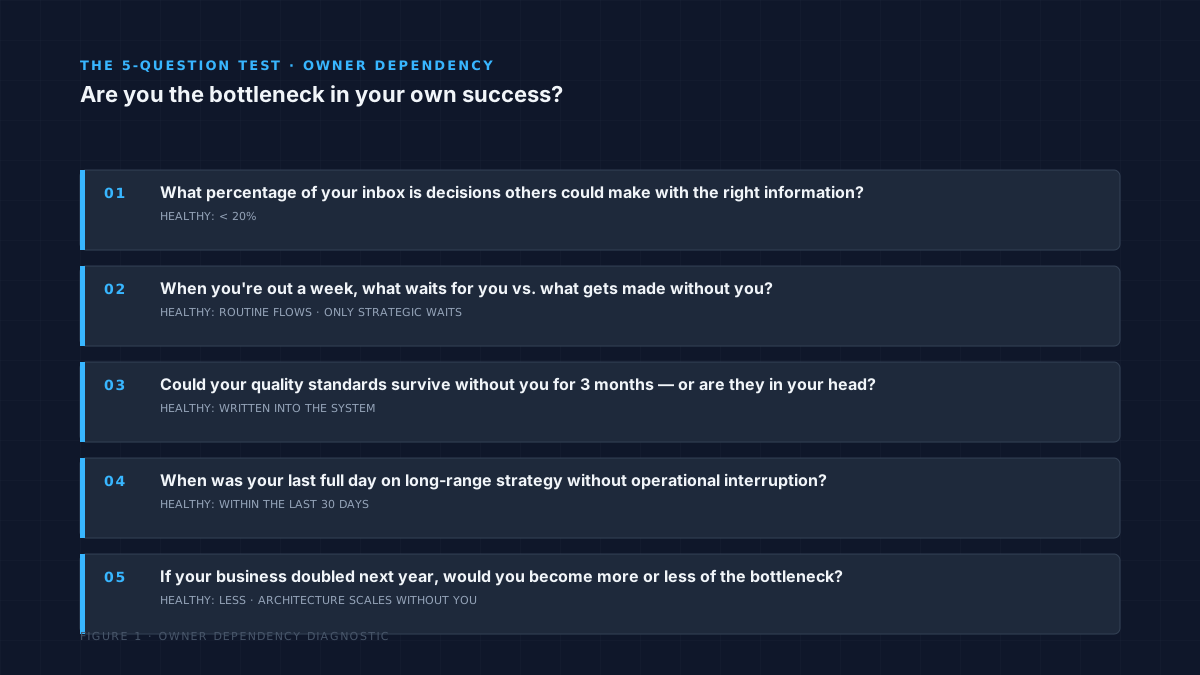
- On a typical Tuesday morning, what percentage of your inbox is people asking you to make decisions they could make themselves with the right information?
- When you're out of office for a week, how many decisions wait for you vs. get made without you?
- If you walked away for three months, would the business's quality standards survive on their own — or are they held in your head?
- When was the last time you spent a full day on long-range strategy without interruption from daily operations?
- If your business doubled in size next year, would you become more or less of the bottleneck?
If you don't like your answers, the problem isn't your team. The problem is the architecture you've built around them. That's good news — architecture can be changed.
Why This Matters Beyond the Business
We don't build software to make your business bigger. We build software to make your business run without you in the middle of everything — so that what you do with the margin (the time, the attention, the presence) can be the actual point.
Productivity is a responsibility. But it's not an identity. The best version of your business is the one that doesn't need you in every moment — not so you can step away, but so you can be more present for the people and the mission that matter most.
Stop operating. Start leading. The shift isn't about working less. It's about working on the things only you can do — and building the system that handles everything else.
How Xeedly Builds the Architecture
Xeedly builds intelligence platforms and operational systems that remove the leader from the middle of everything. Five live deployments across multi-unit restaurants (Sovvrn), HOA management (PropertyDocz, PropertyJobz), property management (Core HOA), property investment (Pando). Same architectural principle every time: decisions get made where the information lives, exceptions get surfaced automatically, standards live in the system, and the leader gets their calendar back. Standup is 2–4 weeks for the core platform.
Questions, answered.
- What does it mean to build a business that runs without you?
- It means the daily operations no longer require your presence to function — but you're still leading, setting direction, holding standards, and doing the strategic work only you can do. It's not stepping away from the business. It's stepping out of the bottleneck so you can do higher-leverage work.
- How do I know if my business depends too heavily on me?
- Five tests: (1) percentage of your inbox that's decision requests, (2) whether decisions wait for you when you're out, (3) whether quality standards live in your head or in the system, (4) whether you can spend full days on strategy without interruption, (5) whether doubling the business would make you more or less of the bottleneck. If most answers are uncomfortable, the architecture needs work.
- Can I just delegate more to fix owner dependency?
- No. Delegation alone fails because information, exceptions, and standards still route through the leader by default. The fix is architectural — give the team visibility into operations through an intelligence layer, surface exceptions automatically with a signal engine, codify standards into the system. Then delegation actually works.
- How long does it take to build a business that runs without you?
- The architecture changes (intelligence layer, signal engine, codified standards) typically take 2–4 months to deploy across a multi-unit business. The cultural and habit changes take longer — usually 6–12 months for leadership patterns to fully shift. The business stops requiring you in the middle of every decision well before the full transition completes.
- What's the difference between a business running without me and a business I've abandoned?
- Presence at the strategic level vs. presence in the daily noise. A business that runs without you in the middle of everything still has you leading direction, holding standards, doing the work only you can do. A business you've abandoned has none of that. The architecture matters — without it, withdrawing causes collapse; with it, withdrawing from operations frees you for leadership.
Ask anything about this briefing.
I've read it. I can synthesize, expand on any section, or point you to related briefings.
Build the architecture, not the dependency
Tell us about your business. We'll show you what an intelligence layer and a signal engine would look like for your operation — and what changes when you're no longer in the middle of everything.
More from PRINCIPAL-LIFE

The Margin Equation: Calendar, Attention, Presence
Most leaders optimize for financial margin and ignore the three margins that actually determine quality of life.

Productivity Is a Responsibility. But It's Not an Identity.
Most high-achieving leaders confuse being productive with being themselves. The conflation costs them when productivity inevitably hits a wall.

Why Success Doesn't Fix the Things You Hoped It Would
The wins are real. The trophies are deserved. And the fulfillment most leaders expected to find doesn't arrive. Here's why.